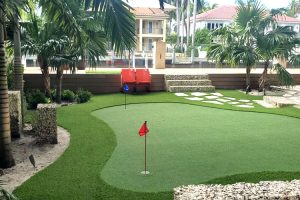
The best artificial grass for a backyard putting green is a short, dense putting turf designed to provide a smooth, predictable ball roll. Unlike standard landscaping turf, putting green grass has compact fibers, a low pile height, and a firm surface that can be customized for the desired speed. The right choice will also depend on how seriously you play, the available space, drainage conditions, and whether the green will be used for putting only or for approach shots as well.
What Type of Artificial Grass Is Best for a Putting Green?
A purpose-built putting turf is the best option. Conventional lawn turf has longer blades that make a golf ball bounce, slow down, or move off line. Putting green turf is manufactured with shorter fibers that create a compact playing surface and allow the ball to roll more naturally.
Two common choices are nylon and polypropylene putting turf. Nylon is firm, resilient, and well suited to greens intended for consistent practice. Polypropylene is generally softer and can deliver an attractive recreational surface when paired with the correct base and infill. Some putting products also use polyethylene fibers to balance appearance, comfort, and playability.
Homeowners comparing materials can review Perdura Lawns’ artificial grass options and discuss which construction fits the planned green. The product should be selected as part of the complete design rather than by appearance alone.
Features to Look for in Backyard Putting Green Turf
The turf must work with the prepared base, contours, cups, and surrounding landscape. When comparing products, pay attention to the following characteristics:
- Low pile height: Short fibers help keep the surface even and reduce resistance as the ball rolls.
- Dense fiber construction: Closely spaced fibers support a stable ball path and minimize irregular movement.
- Consistent surface texture: Uniform texture makes practice more useful because similar putts produce similar results.
- Suitable backing and drainage: A permeable system allows water to move away instead of collecting on the green.
- Compatible infill: The appropriate infill helps support the fibers and can influence firmness and speed.
Color is worth considering, but it should not be the deciding factor. A realistic green that rolls poorly will not provide an effective practice area. Performance, durability, drainage, and compatibility with the installation system should come first.
How Fast Should a Backyard Putting Green Be?
There is no single ideal speed for every home putting green. A casual family green may be designed for a moderate pace, while an experienced golfer may prefer a faster surface that offers a greater challenge. The finished speed is influenced by the turf fiber, pile direction, infill, compaction, base construction, slope, and maintenance.
It is helpful to think about where you normally play. If the purpose of the green is to prepare for local courses, a surface with a reasonably comparable pace may make practice more relevant. If the area will be shared by beginners or children, a more forgiving speed may be practical. Perdura Lawns’ putting green artificial grass service can help homeowners evaluate these priorities before choosing a system.
Putting Turf and Fringe Grass Serve Different Purposes
A complete backyard green often uses more than one artificial grass product. Short putting turf forms the playing surface, while longer landscape turf can create a fringe around it. The fringe provides visual definition and can support chipping practice when the layout is designed for that purpose.
Using the same long-bladed turf across the entire area is usually not a good substitute for dedicated putting grass. It may look like a lawn, but the fibers can interfere with ball roll. Combining complementary products creates a more functional transition between the green and the rest of the yard. Examples of broader residential applications can be explored through the Perdura Lawns website.
Why Base Preparation Matters as Much as the Turf
Even high-quality putting turf will not perform properly over a weak or uneven base. The installation area must be excavated and graded before a compacted aggregate base is added. This foundation supports the surface, establishes the contours, and promotes drainage.
Important installation considerations include:
- Creating subtle breaks without producing awkward or excessively steep slopes
- Compacting the base to prevent low spots and surface movement
- Positioning cups where they provide varied but playable practice lines
- Directing water away from structures and areas with poor drainage
- Securing seams and edges so they do not interrupt ball movement
The direction in which the turf is installed also matters because synthetic fibers have a grain. A thoughtful layout accounts for that grain and avoids seams in critical putting lines whenever possible.
Choosing the Best Artificial Grass for Your Space
Start by deciding how the green will be used. A small practice area for short putts has different requirements from a larger design with several cups, breaks, fringe areas, and room for approach shots. Consider the available dimensions, desired difficulty, typical users, maintenance expectations, and how the green should fit into the surrounding landscape.
Product samples are useful because they allow you to compare fiber density, stiffness, color, and texture. However, the final result depends on the relationship between the turf and the installation beneath it. The best putting green is a complete system—not simply a roll of artificial grass.
Plan a Backyard Putting Green With Perdura Lawns
Perdura Lawns provides putting green artificial grass for homeowners who want a dedicated practice and recreation area in their backyard. The company can help match the turf, base preparation, contours, fringe, and cup placement to the intended use of the space. To discuss a planned installation and available product choices, homeowners can contact Perdura Lawns for project-specific guidance.
Frequently Asked Questions
What pile height is best for an artificial putting green?
A short pile is generally best because it creates a firm, even surface with less resistance against the ball. The exact height should be chosen with the turf construction, infill, and desired green speed in mind.
Is nylon or polypropylene better for a backyard putting green?
Nylon is firm and resilient, making it a strong choice for consistent practice. Polypropylene offers a softer surface and may suit recreational greens. The better option depends on the preferred speed, feel, budget, and installation design.
Does an artificial putting green need infill?
Many putting green systems use infill to support the fibers, add stability, and help control ball speed. The type and amount required depend on the turf product and should follow the specifications for the complete system.
Can regular artificial lawn grass be used for a putting green?
Regular landscape turf is usually too tall for predictable putting. Its longer fibers can slow the ball and cause inconsistent movement, so purpose-built putting turf is the better choice for the main playing surface.